
Popular now
Freemans defies high street slump with sixth year of festive growth

Freemans defies high street slump with sixth year of festive growth

Waitrose secures Surrey site with shopping centre acquisition

Waitrose secures Surrey site with shopping centre acquisition

WHSmith opens three new sites at Manchester and Liverpool airports

WHSmith opens three new sites at Manchester and Liverpool airports

Grocery sales fall 1.9% as shopper habits stabilise

Retail News

In this episode we speak to Matt Dalton, consumer sector leader at Forvis Mazars. Matt discussed the biggest challenges facing the retail sector, from cost pressures and wage increases to polarised property markets and geopolitical shocks, and the ways in which retailers can best navigate these. We also explore how short-term cost-cutting could undermine long-term resilience, and how retailers can best remain agile and adaptable in unforecastable times.

Register to get 1 free article

Reveal the article below by registering for our email newsletter.

No spam Unsubscribe anytime

Want unlimited access? View Plans

Already have an account? Sign in

Take home grocery sales fell by 1.9% over the 12 weeks to 31 October 2021- but are still higher than before the pandemic – up 7.3% compared with 2019, according to the latest figures from Kantar.

Kantar said the results come as consumers’ shopping behaviour “is beginning to stabilise” and that some habits from the pandemic “look set to stay”. It revealed that shoppers are still making 40 million fewer trips to supermarkets per month than in 2019, while a fifth of households order their groceries online each month.

In addition, it found like-for-like grocery price inflation stands at 2.1% in the latest four weeks, its highest level since August 2020. In the latest 12 weeks, inflation is 1.5%, with prices rising fastest in markets such as savoury snacks, canned colas and crisps while falling in fresh bacon, vegetables and cat and dog treats.

Kantar also found that Tesco bucked the wider market decline and was the only retailer to achieve year-on-year growth this period with sales rising by 0.3% over the 12 weeks to 31 October. Almost three quarters of the population made a trip to Tesco in the past three months, helping the retailer to gain market share for the tenth month in a row and boost its proportion of the market by 0.6 percentage points to 27.6%.
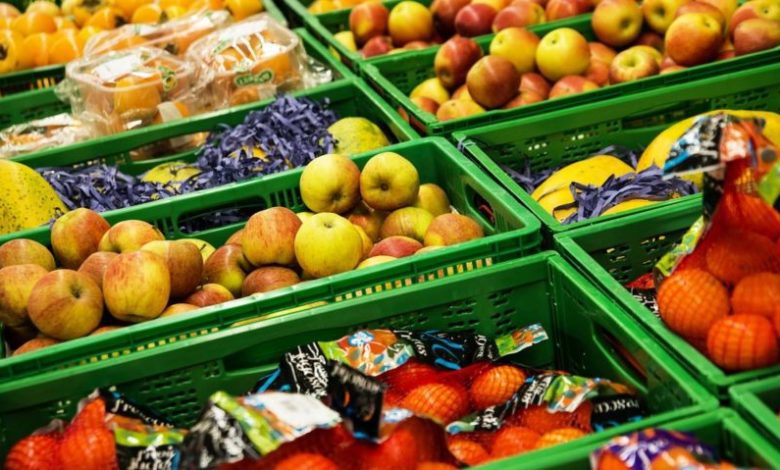
While Lidl’s sales remained flat compared with last year, the grocer performed ahead of the market to nudge up share by 0.1 percentage points to 6.2%. Aldi also increased its share of total grocery sales by 0.1 percentage points and it now holds 7.9% of the market.

Iceland’s market share remained steady at 2.3% this period. Sainsbury’s, Asda and Morrisons’ market shares were 15.2%, 14.3% and 10.0% respectively. Co-op’s market share now stands at 6.3% and Waitrose’s is 5.0%.

Compared with the equivalent period in 2019, all retailers boosted their sales in the latest 12 weeks. Ocado achieved the strongest increase in sales compared with two years ago, growing by 35.7%, while its market share stayed flat at 1.7%.

Fraser McKevitt, head of retail and consumer insight at Kantar, said: “Our shopping habits are beginning to settle at a new baseline as we’ve adapted our lifestyles through the pandemic. The general trend towards bigger, less frequent trips to the supermarket seems set to stay.

“Households visited the supermarket 15.7 times in the past month on average. That’s a slight increase from the 15.3 trips we saw at this time in 2020, but consumers are still making 40 million fewer trips per month than they were in 2019. At this rate of change, it would take three years to get back to our old shopping patterns.”

He added: “Online sales have also levelled out. For the second month in a row, digital sales accounted for 12.4% of the total grocery market. A fifth of households consistently order groceries online each month, becoming long term converts.”

Previous Post
Build-A-Bear launches new 3D Workshop e-commerce offering

Build-A-Bear launches new 3D Workshop e-commerce offering

Next Post
Post-pandemic future is looking bright for UK high Streets

Post-pandemic future is looking bright for UK high Streets

Secret Link