





Register to get 2 free articles
Reveal the article below by registering for our email newsletter.
Want unlimited access? View Plans
Already have an account? Sign in
For decades, the rhythm of the UK grocery sector has been dictated by the twin engines of volume and impulse. From the buy one get one free aisle stacks to the strategic placement of chocolate bars at the checkout, the supermarket was designed to trigger hunger and reward desire. But as we move into 2026, a pharmaceutical intervention is silencing that food noise, and soon the retail giants could be scrambling to catch up.
The rise of GLP-1 agonists, weight-loss injections like Wegovy and Mounjaro, is no longer just a medical story, it is a structural shift in the UK’s £250bn grocery market. With an estimated 6% of UK adults now using these medications, and that number expected to climb as oral versions hit the market, retailers like Marks and Spencer, Ocado, and Asda are pivoting from a model of ‘more for less’ to one of ‘less, but better’.
The emergence of satiety spending
The most immediate impact of GLP-1 medications is the suppression of appetite and the dampening of the brain’s reward pathways. This has birthed a new consumer profile, the intentional shopper. Dr Sophie Dix, head of Medical Affairs at MedExpress, has observed this shift first-hand. MedExpress supported nearly a million people on weight-loss journeys in 2025 alone, dispensing over 5.5 million prescriptions. “What we see with weight loss medications is a changed relationship with food,” Dr Dix explains. “Customers don’t disengage from food, but become more intentional about it. They commonly describe thinking about food less and being less impulsive about eating.”
This intentionality is manifesting in what industry experts call satiety spend. Instead of filling trolleys with multi-packs of crisps and calorie-dense snacks, GLP-1 users are trading up. According to Dix, they buy fewer items but prioritise high-quality proteins, fibre, and nutrient-dense ingredients. “Scientifically, this reflects how GLP-1 acts on appetite regulation. By mimicking the natural GLP-1 hormone, these medicines signal satiety to the brain. They also affect the brain’s reward system and dampen the response to highly palatable, unhealthy foods,” Dix notes. Additionally, they also slow the digestive system down, meaning meals feel more filling for longer. Together, these effects shift behaviour away from impulsive snacking and towards more intentional, meal-based eating. Because overall intake is often reduced on GLP-1s, quality really matters. Dix says: “You’re likely to see less emphasis on volume or indulgence, and more on foods that support energy, muscle mass and general wellbeing. From a retail perspective, that could mean smaller baskets, but potentially higher value per item.”
Supermarket strategy: From aisles to aesthetic
“Retailers that quickly develop their own healthier ranges, with better portion control, higher protein and everyday health benefits, will gain a bigger share of sales. Meanwhile, big brands will be left trying to catch up.” — Jay Conway, BearingPoint
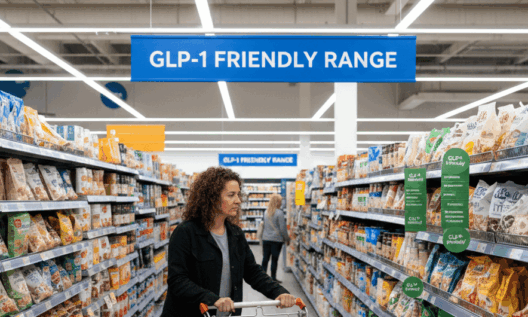
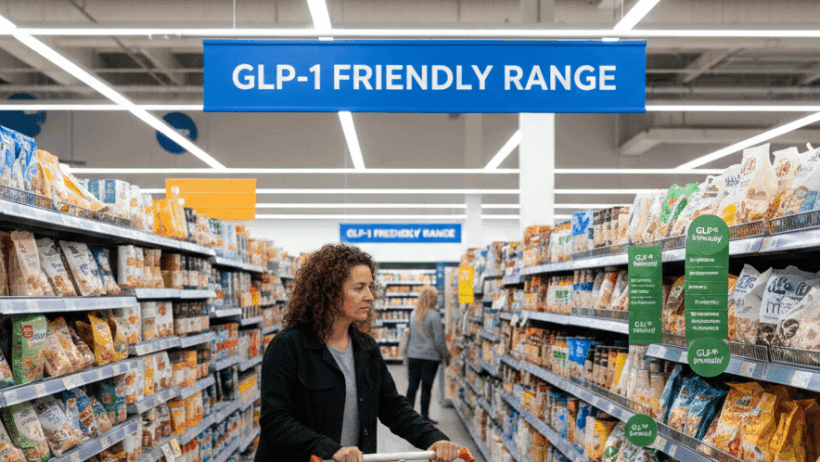
Retailers have been quick to spot the trend. Supermarkets such as Ocado recently launched a virtual weight management aisle, featuring everything from 100g steak portions to high-end powdered supplements. Meanwhile, M&S has introduced its Nutrient Dense range, and the Co-op is plugging mini meals designed for those with reduced stomach capacity. However, the way these ranges are marketed is a point of contention. Eleanor Simpson-Gould, senior retail analyst at GlobalData, warns that grocers risk missing long-term demand if they treat these meals as a niche medical trend. “Grocers must expand GLP-1 inspired ranges to highlight the universally appealing benefits such as high protein, high fibre, and nutrient dense, rather than marketing solely focused on GLP-1 terminology,” she says. “The winners will be grocers that treat GLP-1-inspired meals as ‘healthy first,’ and not ‘GLP-1 first’.”
GlobalData’s research also suggests that while 1.6 million adults in Great Britain used these drugs in the last year, the influence of the drugs is spreading to non-users who simply want to eat less and better. Simpson-Gould argues that M&S and Co-op have the most commercially sensible approaches by integrating these products into broader health platforms rather than stigmatising them with medical labels. Conversely, Morrisons has taken a more overt path with its GLP-1 Friendly range. While this provides clarity, it may deter shoppers seeking discretion. Jay Conway, director at BearingPoint and former director at Sainsbury’s and Argos, believes the move toward private labels in this space is inevitable. He says: “Retailers that quickly develop their own healthier ranges, with better portion control, higher protein and everyday health benefits, will gain a bigger share of sales. Meanwhile, big brands will be left trying to catch up by changing their recipes in response.” Dix is also of the opinion that brands and retailers have an opportunity here to move away from decades of ultra-processed, high-fat, high-carb food being the cheapest and easiest option. “Supporting access to nutrient-dense foods, in a way that’s affordable and convenient, is likely to matter far more in a GLP-1 era than promoting diet-labelled products,” she says.
Does smaller mean better?
As supermarkets introduce smaller portions at prices similar to their standard counterparts, they face a branding challenge: how to avoid the shrinkflation tag. If a 280g meal costs the same as a 400g one, consumers need to be convinced of the added value. Mark Whalley, co-founder of Explners, notes that the grocery market is currently dominated by “everybody worrying that the other guys are on to something.” He points out that “being small is in itself a benefit. That’s what they’re effectively saying when the price doesn’t go down with the portion size. It’s just whether there’s an actual need for these products, or whether people could just eat a little bit less of the products that they already buy.”
For the consumer, the justification lies in nutrient density. Ayesha Bashir, a weight loss expert and prescribing chemist at myBMI, argues that these meals are essential for health, not just convenience. “Prioritising nutrition alongside medication is one of the most important aspects of a weight loss journey,” Bashir says. “Without proper nutrition, restricted diets can contribute to low energy, hair thinning, and loss of muscle.” Bashir advocates for “smaller but nutrient-dense” options to become a high-street staple, helping anyone build healthier habits without the tediousness of calorie-counting. This sentiment is echoed by Dr Debra Marcos, medical director at Weight Medics, who warns that these products must be more than just lite versions of junk food. “People on GLP-1 therapy benefit most from foods that are protein-rich, nutritionally balanced, and gentle on the digestive system,” she explains.
Store layout and cognitive load
Beyond the products themselves, the Jab-uary trend is forcing a rethink of the physical store environment. Patrick Young, managing director of PRS IN VIVO, uses eye-tracking studies to understand how shoppers navigate these new ranges. He notes that GLP-1 users are often mission-led shoppers who are easily overwhelmed by complex environments. “To reduce cognitive load, retailers should focus on simplifying visual hierarchies: clear aisle signposting, fewer competing claims per pack, and more intuitive adjacencies,” Young advises. He suggests that grouping by functional needs (e.g., high protein) rather than by brand could be the future of store layout.
This shift threatens the traditional end-of-aisle bulk promotion model. Simon, chief strategy officer at Initials CX, recently hosted a panel on the impact of GLP-1s. He believes that while bulk discounts still work for stockpile-able goods, perishable impulse items are at risk. “Brands that cater to impulse needs are going to be at greatest risk with GLP-1s actively switching off consumer desire and ‘food noise,'” he warns. Simon suggests that brands traditionally relying on indulgence must adapt. “Indulgence will still endure as a needy state, but it’s likely that the nature of that indulgence will change as people become more satisfied with less,” he says. This could lead to smaller, more premium solutions where consumers buy a single, high-quality truffle rather than a large bar of chocolate.
Managing the risks of portion-control
“Supporting healthier choices doesn’t need to feel ‘medicalised or judgemental’ to be effective. Messaging that focuses solely on eating less risks being overly simplistic and potentially harmful.” — Dr Sophie Dix, MedExpress
With the commercialisation of medical weight loss comes a significant ethical responsibility. Supermarkets are not clinics, yet they are increasingly positioning themselves as partners in medical journeys. Dix is clear on the risks: “Messaging that focuses solely on eating less, without acknowledging nutritional needs, risks being overly simplistic and potentially harmful to overall health.” She warns that inadequate intake on these drugs can lead to fatigue and muscle loss, undermining long-term health. “Retailers must ensure they are not unintentionally promoting restricted diets which do not support long-term health,” Dix insists. Safeguards must include clear nutritional labelling that prioritises protein and micronutrients over mere calorie counts. There is also the issue of the ultra-processed (UPF) backlash. As Callender points out, ready meals face a “double threat.” With 56% of GLP-1 takers actively seeking out healthier foods, the pressure on ready-meal brands to reformulate and strip out additives is immense. Dix states: “Supermarkets are well placed to offer a more enabling approach, for example, through clear nutritional labelling, balanced portion options and stigma-free language. Supporting healthier choices doesn’t need to feel medicalised or judgemental to be effective.”
The next chapter for supermarkets
As we look toward the end of the decade, the supermarket of the future looks remarkably different from the volume-driven stores of the 2010s. The industry is moving toward a post-satiety world where the goal is no longer to maximise calories per pound, but to maximise nutrition per mouthful. Conway believes this change is permanent. “GLP-1 will quietly reshape private labels faster than brands expect,” he says. He envisions a world where retailers use their data to predict the nutritional needs of patients and provide curated, functional baskets that prevent the common side effects of weight-loss drugs. According to him, the transition from injectables to oral tablets, expected within the next 18 months, will be the ultimate accelerant. As the barrier to entry falls, GLP-1 usage will move from a significant minority to a massive structural portion of the population. Callender adds that brands that fail to respond to consumers’ needs are now and always have been destined to fare poorly. He says: “In future, snack brands will be faced with a choice – play to sensory hedonism, albeit in a new and most probably smaller formats, or embrace the GLP-1 powered desire for health and nutrition and look to optimise taste and texture within these ingredient led restrictions.”
Dr Dix hopes this shift will finally address the root cause of the UK’s obesity crisis: the affordability of high-quality food. “Obesity didn’t rise because people suddenly had a collective loss of willpower; it coincided with the widespread availability of cheap, ultra-processed food,” she says. “If supermarkets can make nutrient-dense, high-quality food genuinely accessible, they’ll play a key role in helping customers sustain healthier patterns long after the initial weight-loss phase.” Ultimately, the rise of “Jab-uary” might do more than just help individuals lose weight. It might force the UK food industry to dismantle the volume-first infrastructure that helped create the obesity epidemic in the first place. In the supermarket of 2026, the loudest sound is no longer the food noise of impulse buys, it is the quiet, intentional hum of a population finally learning to be satisfied with less.