Inside Quiz’s measured return to store expansion
Quiz is entering a new phase after two difficult years and a brief spell in administration. Now privately owned and trading more strongly, the fashion retailer is preparing to expand again. Its redesigned store concept, tighter cost base and broader product offer will determine whether this cautious return to growth can last.
Register to get 1 free article
Reveal the article below by registering for our email newsletter.
Want unlimited access? View Plans
Already have an account? Sign in
Quiz Clothing is entering a new phase. After two difficult years marked by falling demand due to fading relevance with its core shopper, and a short spell in administration, the Glasgow-based fashion retailer is preparing to expand again. The business, which operates 40 UK stores and works with franchise and online partners internationally, plans to open between five and 10 new locations in the next 12 months.
The decision follows a comprehensive operational overhaul that began earlier this year. The reset was designed to stabilise performance and reposition Quiz in a value-fashion market that continues to come under pressure from higher costs, the threat of other competitors and cautious consumer spending.
“In the years that followed its AIM listing, Quiz’s troubles could be chalked up to the consequences of shortening trend lifespans within the fashion industry…”
As Quiz chief executive Sheraz Ramzan shares, the retailer’s leadership believes that the business is now trading more strongly and has a clearer brand direction than it has had in several years. The challenge is whether the improvements are enough to support fresh investment in physical retail.
Founded in 1993 as a small occasionwear retailer, Quiz hit its stride during the 2010s by offering fashion-forward dresses, jumpsuits and evening pieces at accessible prices. It floated on AIM in 2017 with ambitions to accelerate its store rollout and expand online.
In the years that followed its AIM listing, Quiz’s troubles could be chalked up to the consequences of shortening trend lifespans within the fashion industry, which means that some brands can get left behind when they’re no longer ‘it’. Beyond that, the pandemic weakened demand for occasionwear and exposed overexpansion in parts of the store estate. It was in 2023 that Quiz announced restructuring measures, and by early 2025 it had entered administration and closed 23 stores.
The business is now privately owned and steadily repositioning itself as a more agile, design-led brand with tighter cost control and broader product appeal. According to the chief executive, the turning point came with the streamlining programme introduced in February 2025.
“Like-for-like sales rose 14% over the summer, and online growth strengthened in key regional markets.”
“Through the streamlining process we have managed to close poor performing areas of the business which had weighed down on the overall company performance,” Ramzan says.
This included closing its lowest contributing stores and concessions, exiting unprofitable trading partnerships and reducing headcount in affected parts of the business. Ramzan says the changes “resulted in more focus and investment channelled toward product design and broadening the product offer to help drive LFL sales.”
He also highlights the impact of leaving public markets, adding, “De-listing the company from AIM has allowed us to make these difficult decisions and focus on the turn-around without the distraction of public markets.”
The steps have helped to rebalance the business. Like-for-like sales rose 14% over the summer, and online growth strengthened in key regional markets. Quiz now presents a leaner cost base and a more focused product direction, which has laid the foundation for a return to expansion.
Quiz plans to open a controlled number of new stores across the UK, concentrating on London and the South. The programme is being advised by Beacon Brooke Property Consultants, which, according to Ramzan, is approaching the property market with discipline.
“Quiz wants fewer stores, but it wants them to be better located, better designed and more closely tied to the company’s omnichannel strategy.”
“Negotiations can be challenging when there are many new and international brands looking for space in shopping centres,” Ramzan points out. “It is important to remain disciplined and only agree to deals which provide certainty around achieving contribution targets.”
He adds that the business is prepared to invest more confidently in locations where it has historical trading data. “In centres where we have some trading history we can be more optimistic with sales targets and cap-ex spend. If there is less certainty we would seek more flexibility around lease length and take a more prudent approach.”
This approach reflects a shift away from the widespread expansion of the late 2010s. Quiz wants fewer stores, but it wants them to be better located, better designed and more closely tied to the company’s omnichannel strategy.
“While Quiz’s heritage lies in its partywear and occasion dressing, this reliance on event-driven categories made the business vulnerable during the pandemic…”
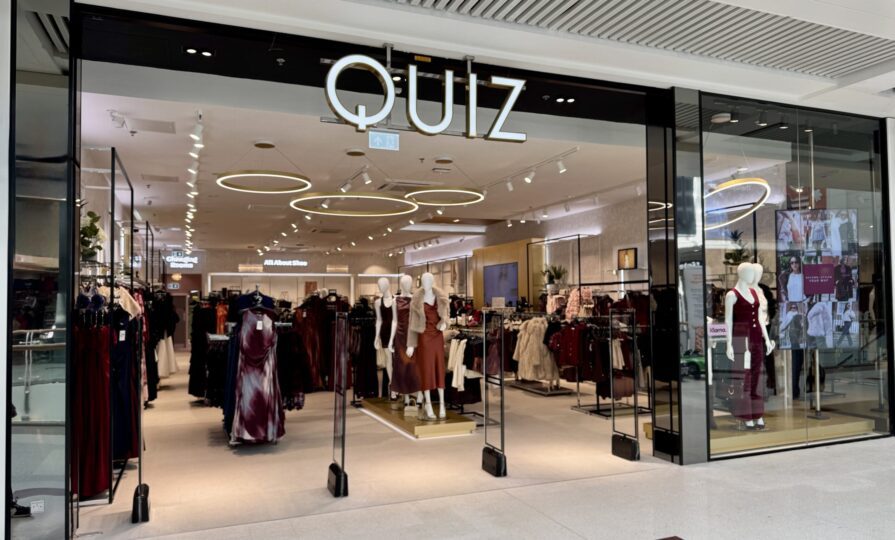
Everything now hinges on the success of the Braehead concept, launched in September as the template for future stores. The 1,800 sq ft location features a softer colour palette, white and gold fittings, and digital screens for video-led content. The aim is to present a more sophisticated and aspirational environment while keeping the value element that has always defined the brand.
“We have evolved our retail formula at Quiz and, encouraged by a strong uplift in like-for-like retail sales over the summer, we are confident the new strategy is working,” Ramzan explains. “The plan is to now expand in the right locations through units that provide the best possible backdrop for our extended product offering.”
Quiz found that customer responses to Braehead have been encouraging. September sales rose 20% across the business, supported by improved fits, extended sizing options and better fabrications. Ramzan says the store generates stronger conversion rates and higher average transaction values than older formats. He attributes this partly to the broader product offer, which now includes coordinated separates, contemporary tailoring and more versatile day-to-evening ranges.
“The brand’s latest 250-piece partywear collection, launched at the end of October, has delivered a strong start to the Christmas trading period.”
While Quiz’s heritage lies in its partywear and occasion dressing, this reliance on event-driven categories made the business vulnerable during the pandemic and contributed to its more recent decline. In order to make the brand more versatile to high street shoppers the company has had to broaden its offer, strengthening fabric quality and sharpening fits to appeal to a more varied set of customer occasions.
It is a very good sign that analysts have noticed this shift. Claire Wallis, consumer goods and retail director at BearingPoint, says, “Quiz’s return to the high street does feel a lot like a brand that has learned from its experiences and evolved. They’ve really taken a look at what is going on in the market and come back with a sharper proposition.”
Wallis adds that the changes match how customers shop today. “I have also recognised Quiz as the go-to for occasionwear but they have now moved beyond this to a more well-rounded offer with clear improvements in fit and quality.”
She notes that the business appears more responsive and operationally agile, saying that “shorter buying cycles and stronger nearshore supplier relationships mean they can react quickly to trends.”
“Although Quiz expects long-term growth to come from international online markets, UK stores remain central to its strategy.”
The brand’s latest 250-piece partywear collection, launched at the end of October, has delivered a strong start to the Christmas trading period. Early indicators show rising demand for mesh, satin and velvet, particularly in black, bottle green and brown. Sales of footwear and accessories have likewise increased, with gold becoming the preferred metallic tone.
Regional data shows Glasgow, Manchester, Sheffield and London leading demand, with an average basket value of £60.
Although Quiz expects long-term growth to come from international online markets, UK stores remain central to its strategy. Ramzan says physical retail supports online performance in local areas and plays an important role in brand visibility. “We aim to be an omni-channel brand and we find that online sales in a particular area are boosted significantly by the presence of a local store.”
Having experienced this symbiotic relationship between a high street presence and online store, Ramzan believes physical retail has regained importance as online growth matures and customer expectations around experience increase.
Wallis agrees. “Physical retail is appearing to be a strong part of their plan. The brand does demonstrate some cautionary steps with smaller numbers of new stores but what does excite me is how they are integrating their digital formats.”
Quiz enters 2026 with a clearer identity, tighter cost structure and early trading momentum. Its improvements are promising, but Wallis stresses that the brand needs to remain “keenly sharp and disciplined in decision making” to secure lasting recovery.
The next phase of expansion will test the resilience of Quiz’s new strategy. If the Braehead model can repeat its performance across the next set of stores, the retailer may establish a more sustainable path back to growth. If not, the recent gains may prove temporary in a market where value-fashion competition remains intense.
For now, Quiz is making a measured bet that the combination of better stores, stronger product and tighter discipline can rebuild shopper trust and reposition the brand for the long term.