
Register to get free articles
Want unlimited access? View Plans
Already have an account? Sign in
Christmas for retailers and the hospitality industry will be challenging due to rising bills that will have started to bite since September, the retail intelligence experts at MRI Software, formerly Springboard, are forecasting.
It found that this year, footfall across all UK retail destinations will decline on a month-to-month basis, with the September decline in footfall at -3.2%, the largest month-on-month decline since January 2023.
For the 2023 Christmas period, MRI Software is forecasting that the financial constraints facing households as a result of high inflation and interest rates will lead to the drop.
Whilst interest rates were not raised in September, around half a million households face the end of their fixed rate mortgages in early 2024, when they know they will face a significant increase in payments.
Diane Wehrle, Insights Director at MRI Software, explains: “With this additional financial burden for so many consumers just over the horizon, MRI Software anticipates that this will curtail consumers’ propensity to shop. It is forecast that spending pressure will start to bite from September onwards, with drops in footfall from month-to-month over the three months from September to November, only increasing from November to December in the run up to Christmas.
“In each year between 2009 and 2019, footfall dipped in September from August as a result of a drop in consumer demand following the end of the holiday season and the start of the school term. Both 2020 and 2021 were heavily disrupted by Covid-19 and again in 2022 – but to a lesser degree. However, this year the drop in footfall will be further impacted by the hit on many household budgets due to higher inflation and interest rates.”
MRI Software predicts that in October, footfall will continue to decline on a monthly basis, albeit marginally (by -0.1%), remaining virtually flat from October to November (a month-on-month drop of -0.05%), but then increasing from November to December by +5.1%.
The forecast rise in footfall from November to December 2023 will represent the largest month-on-month increase in 2023, but it will still be below the increase in footfall of +5.8% that occurred between November and December 2022.
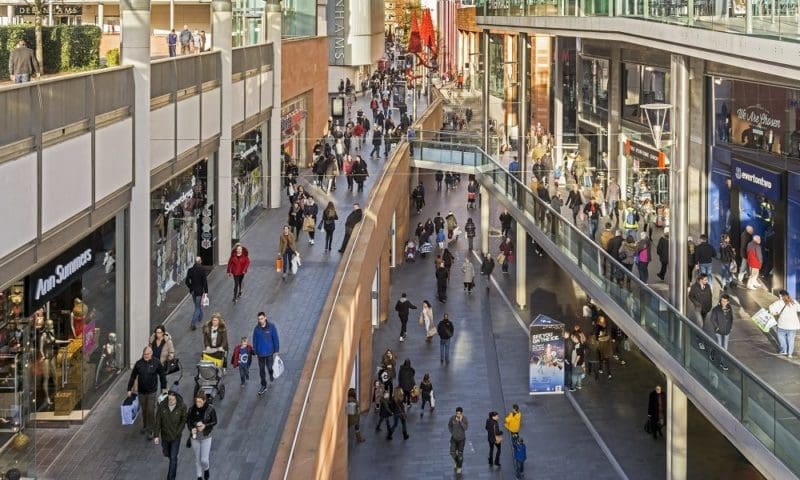
The stronger trading performance in November and December will be driven by uplifts in footfall in retail parks and shopping centres resulting from increased footfall, firstly over Black Friday and then during December in the run up to Christmas.
Following Black Friday, the rise in footfall of +5.1% from November to December will emanate from increases in footfall of +6.5% in retail parks and +10% in shopping centres, whilst in high streets footfall will rise by a far more modest +2%.
The forecast declines from month-to-month from September to November and then just a modest rise in the final month of the year, will push footfall below the 2022 level from October 2023 onwards.
In October, footfall across all UK retail destinations will be -1.3% below the 2022 level, -0.9% below 2022 in November and -1.9% below 2022 in December.
Retail parks will continue to be the most resilient of the three key destination types, with an uplift from 2022 in each month from September to December, averaging +0.9% above 2022 over the four months as a whole.
In both high streets and shopping centres, the gap from the 2019 footfall level will remain at a much wider level. In August high street footfall was -13.4% below the 2019 level and -14.8% below 2019 in shopping centres. MRI Software’s forecast anticipates that this gap will widen further by December to -15.5% in high streets and -17.7% in shopping centres.
Wehrle said: “The largest hit on footfall will be felt by high streets, which is generally the case in the run up to Christmas as shoppers head to larger shopping centres and retail parks which lure shoppers through a wide range of brands in large stores in a single destination.
“Despite this, we are forecasting that the drop in footfall from 2022 will be of a similar magnitude in both high streets and shopping centres in December (-2.5% and -2.6% respectively). However, over the four months from September to December, footfall in shopping centres will average just -0.3% below the 2022 level versus -1.7% in high streets.”